
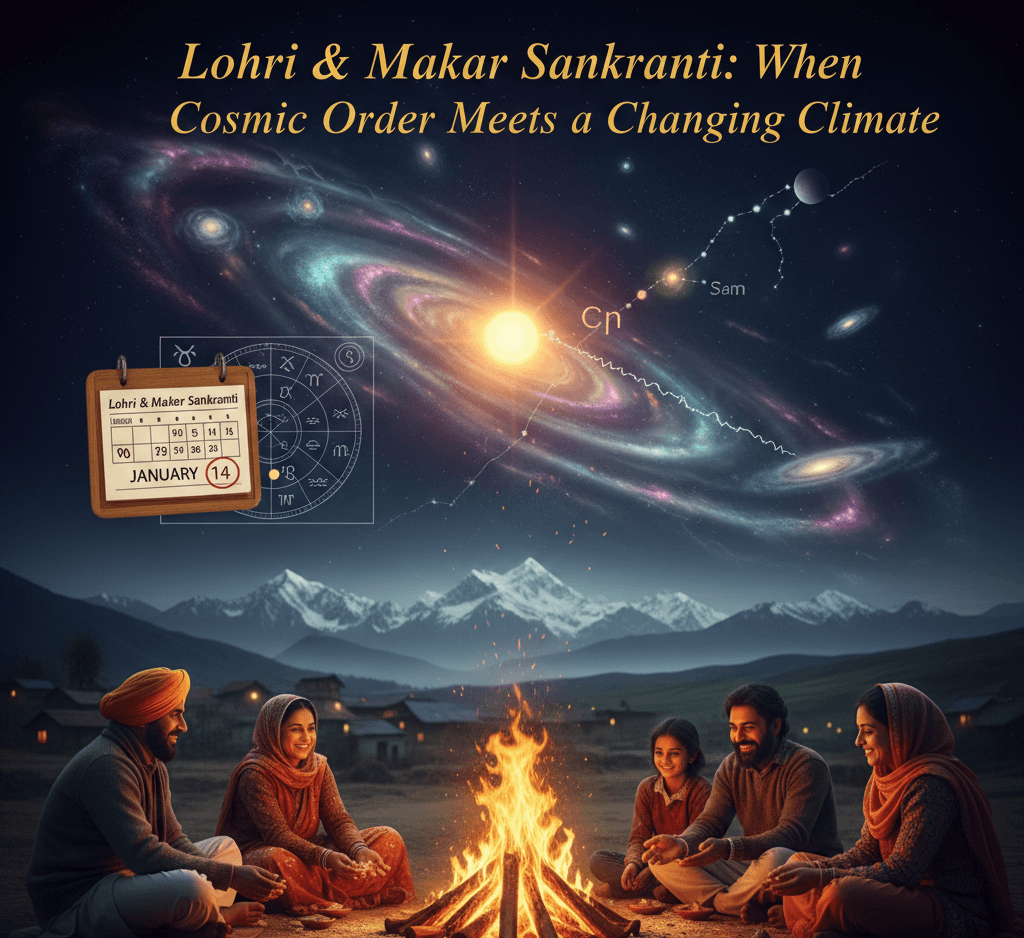
In Sanatan tradition, festivals are not mere dates on a calendar; they are conscious alignments with astronomy, planetary motion, and the rhythm of nature itself. Lohri and Makar Sankranti arrive at one of the most crucial celestial transitions of the year, when the Sun changes its cosmic direction and begins its northward journey.[file:2] These festivals were designed as reminders of balance—between light and darkness, discipline and gratitude, consumption and conservation.[file:2]
Makar Sankranti: The Karmic Threshold
Makar Sankranti marks the moment when Surya Dev enters Capricorn, or Makara Rashi, initiating Uttarayan.[file:2] Astronomically, this transition increases daylight hours and gradually warms the Northern Hemisphere.[file:2] Astrologically, Capricorn is ruled by Saturn, the planet of karma, responsibility, discipline, and collective accountability.[file:2] This planetary association transforms Makar Sankranti into more than a harvest festival; it becomes a karmic threshold, subtly reminding humanity that every action carries long-term consequences.[file:2]Lohri: The Sacred Fire Ritual
Lohri, celebrated around the same period, centers around the worship of Agni, the fire element.[file:2] Traditionally, Lohri was observed at the peak of winter, when biting cold winds prevailed and snow-covered hills stood as silent witnesses to nature's dormancy.[file:2] The bonfire symbolized survival, transformation, and gratitude toward nature's generosity. Offerings made to the fire—grains, sesame, jaggery—represented a harmonious exchange between humans and the environment.[file:2] Fire was not an indulgence; it was a necessity, respected and revered.Climate Change Through an Astrological Lens
However, the seasonal context that once defined Lohri is undergoing a disturbing transformation. Regions that were historically blanketed in snow during this period, particularly the Himalayan belt, now witness delayed or diminishing snowfall.[file:2] Winters feel shorter, erratic, and at times almost absent. From an astrological viewpoint, planets continue to follow their ordained paths without deviation. It is not the celestial order that has changed, but the human relationship with nature that has fractured.[file:2] Key Planetary Influences:- Saturn: Mass behavior and consequences
- Venus: Natural resources and ecological balance
- Moon: Water cycles and climate patterns
The Message of Uttarayan
Uttarayan has always been regarded as an auspicious phase, associated with spiritual ascent, clarity, and movement toward light. Yet light without wisdom can turn into heat without restraint. The Sun rises stronger each day, faithfully fulfilling its cosmic duty, while Earth struggles under the weight of human excess.Path Forward: Restoring Dharma
Lohri and Makar Sankranti together convey a subtle but powerful message:- Sun entering Capricorn calls for discipline and accountability
- Fire of Lohri urges transformation through restraint and gratitude
- Observing Makar Sankranti with charity + mindful living
- Reducing waste as Saturn worship
- Respecting water, land, food to balance lunar/Venusian energies